2026 Best Office Furniture Tables for Modern Offices
The best office tables do more than fill a floor plan. They shape how teams meet, focus, share equipment, and move through a workday. Hybrid schedules have made flexibility important, but daily details still matter: a table that wobbles, crowded cable ports, or cramped legroom can quickly disrupt a meeting.
Gensler’s 2024 Global Workplace Survey covered 16,000 knowledge workers across 15 countries and reported an average of 3.5 office days per week. That matters. Even when employees split their time, offices need practical spaces for collaboration and focused work. An Office Furniture Table should suit its actual job, whether that means hosting a six-person project meeting or giving one employee room for a laptop and notes. A showroom photograph rarely reveals how a surface performs after months of use. Not always.
This guide to the 2026 best office furniture tables considers size, materials, stability, cable management, and adaptable layouts. It also points to ANSI/BIFMA X5.5, a desk-products standard that offers a useful reference for evaluating durability and safety testing. Buyers should still confirm each product’s specifications and test documentation; a standard name alone does not prove every model has been certified. The right choice depends on the room, users, and budget. Some trade-offs remain. A compact table saves space, yet may feel restrictive during shared work. A larger surface gives people more room, but can make circulation harder.
What Defines an Office Table for a Modern Workplace?
A modern office table is more than a flat surface with four legs. It should support changing tasks, shared work, and comfortable posture without dominating the room. Height, clear legroom, stable construction, and a surface that fits laptops, papers, and occasional team discussions all matter. ANSI/BIFMA X5.5 sets performance tests for desk products, including stability and durability. These tests offer a practical reference, though they cannot tell you whether a table suits your team’s daily habits.
The World Green Building Council’s 2014 report, Health, Wellbeing & Productivity in Offices, notes that people can represent about 90% of a business’s operating costs. That makes usable work settings worth considering, not just their purchase price. A table with reachable power access and enough elbow room can reduce small interruptions during focused work. In a meeting area, rounded corners and space for chairs help people move without bumping knees. Small details matter. Yet no table fixes poor lighting or constant noise. That is an imperfect boundary, and worth remembering when choosing furniture.
Which Types of Office Tables Suit Different Work Settings?
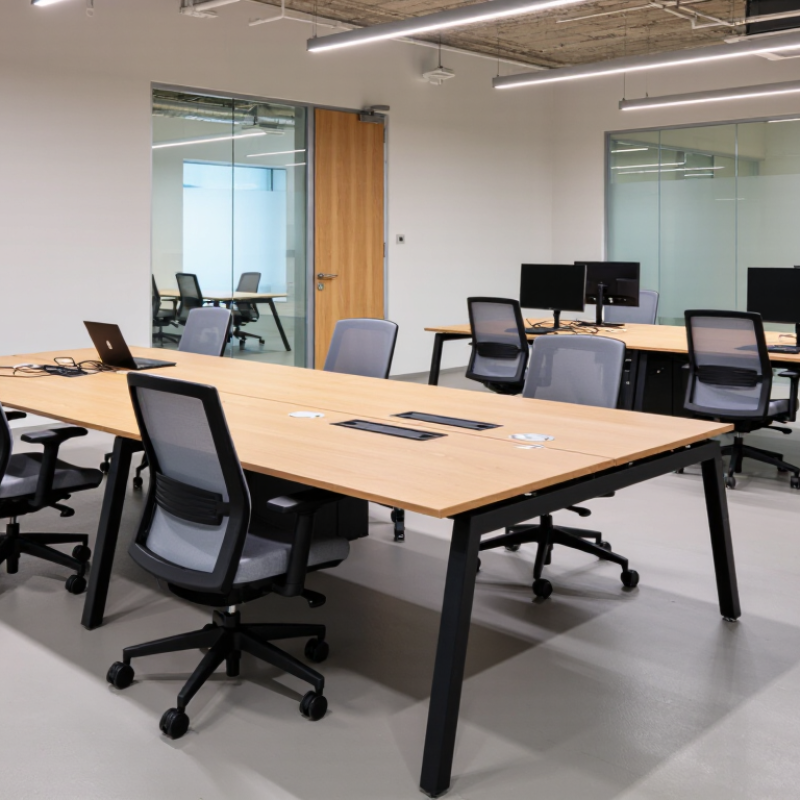
A table should fit the work, not just the floor plan. In open offices, shared bench tables support quick collaboration and keep cable routes easier to manage. Choose enough depth for a monitor, keyboard, and notebook; cramped surfaces invite clutter. Small meeting rooms often suit round or compact boat-shaped tables, which help people see one another without leaning across corners. For focused tasks, individual desks with modest privacy screens can reduce visual distractions. They are not soundproof.
Training rooms benefit from folding or nesting tables that can shift between presentations and group exercises. Check legroom, locking casters, and whether folded tables fit through doorways. Reception areas may need a low table for visitors, while staff require a separate work-height surface. Looks matter, but daily reach matters more. A common planning miss is forgetting chair pullback space. A polished layout can still obstruct a busy aisle, and no table type suits every team.
Tips: Test the table with the intended chair and a full work setup. Keep power access reachable, and leave space for chairs to slide back. Measure the room on site; floor plans can miss awkward corners.
2026 Best Office Furniture Tables for Modern Offices
Which table types suit different work settings? Compare representative tabletop areas.
Areas are calculated from representative tabletop dimensions: desk 48 × 24 in, bench workstation 60 × 30 in, training table 60 × 18 in, round meeting table 48 in diameter, and conference table 96 × 48 in. Desks suit individual work, bench tables support shared workstations, training tables suit flexible classrooms, round tables encourage small-group discussion, and larger conference tables accommodate team meetings. Actual dimensions vary by room and use.
What Materials and Features Matter Most in 2026?
In 2026, the best office tables balance durability, repairability, and everyday comfort. A solid worktop should resist scratches, heat marks, and cleaning products, while its edge remains smooth against forearms. Recycled-content laminate can be practical in busy areas; responsibly sourced wood offers warmth but needs suitable coatings and care. Durability matters. The U.S. EPA’s Advancing Sustainable Materials Management report estimated that 12.1 million tons of furniture and furnishings entered the U.S. municipal waste stream in 2018. That figure covers many types of furniture, not office tables alone, but it underlines why replaceable parts and long service life deserve attention.
Materials are only part of the decision. Look for stable legs, accessible cable routing, and a height that suits the tasks performed at the table. In shared spaces, rounded corners and surfaces that clean easily can reduce daily wear and small bumps. Adjustable tables may support varied users, though adjustment ranges and mechanisms should be checked in person. A feature list cannot replace a fit test. BIFMA’s ANSI/BIFMA X5.5 standard sets performance requirements for desk and table products, making it a useful reference when comparing structural testing claims.
Ask how the table handles a real workday: laptop cables crossing the surface, coffee rings near the edge, and chairs pulled in from different angles. A beautiful finish can still show fingerprints. I would also check whether damaged tops can be replaced without discarding the frame; that detail is easy to overlook, and not every supplier makes repair simple.
How to Choose an Office Table for Space, Comfort, and Use
Measure the room before choosing an office table. Note door swings, window positions, and the space needed to pull out a chair. A large tabletop may look useful in a showroom but crowd a narrow walkway at home. Match its shape to the work: a compact rectangular surface suits a laptop and notebook, while shared projects need clear elbow room. Check that your knees fit beneath it and your forearms rest comfortably when typing. Small details matter.
For longer workdays, consider an adjustable-height table, but treat it as one option, not a cure-all. A 2018 Cochrane systematic review found sit-stand desks reduced workplace sitting by about 100 minutes per workday in short-term studies; the reviewers rated the evidence as low certainty. Build in room for a monitor, keyboard, and papers without stacking them at the edge. Test the table with your actual chair and equipment, if possible. A perfect fit is rare. I would also recheck measurements after moving storage or adding a second screen; office setups change, sometimes in ways we don’t notice until the desk feels cramped.
How to Compare the Best Office Tables for Modern Offices
Comparing office tables starts with the work they must support. Measure the room, chair height, and equipment before judging appearance. A laptop, monitor, and notebook need more usable depth than a laptop alone. Check the table’s height range, leg clearance, edge shape, cable access, and stability. A quick test helps: sit down, place both feet flat, and reach the keyboard without lifting your shoulders. Small details matter.
For durability, ask suppliers for test documentation against ANSI/BIFMA X5.5-2021, a standard for desk and table products. It covers performance tests, but compliance alone cannot confirm that a table suits every room or user. Adjustable models deserve closer comparison. A 2018 Cochrane review found sit-stand desks reduced workplace sitting by about 100 minutes per workday in short-term studies; the evidence was low certainty. That is useful context, not a promise of better health or productivity. Measure the adjustment range against actual users, and check whether controls feel simple during a busy day. Test it.
I would also compare surface finish, weight capacity, cleanability, and warranty terms side by side. Bring a tape measure. Put a real monitor on the sample, if possible. One awkward point: wider tables can improve working space but crowd circulation. Choose the smallest surface that fits the real task, then verify cable routes and chair movement before ordering.