China Top Sandwich Box Manufacturer and Supplier
Choosing a reliable China top Sandwich Box manufacturer requires more than comparing prices. A dependable supplier should understand food packaging, production control, and everyday customer needs. This guide explores how Chinese manufacturers design, produce, and supply sandwich boxes for cafés, schools, catering businesses, and retail brands.
A practical Sandwich Box should protect food during transport and storage. Its lid should close firmly without damaging soft bread. Smooth edges matter when customers open the box quickly. Materials may include food-grade PP, PET, paperboard, or recyclable options, depending on the application. Experienced suppliers can provide samples, material details, production photos, and relevant food-contact testing records. They should also explain minimum order quantities, lead times, printing methods, and packaging procedures clearly.
Customization can include size, color, logo placement, compartments, and window design. A capable factory checks dimensions before mass production. It also inspects sealing, stacking strength, appearance, and cleanliness. Small details often affect the final customer experience. A box that bends in a delivery bag is not a successful package.
However, no manufacturer is perfect. A polished sample may not reveal every production challenge. Buyers should request updated samples and confirm specifications in writing. Communication can also become unclear when designs change frequently. Honest suppliers acknowledge these risks and offer practical solutions.
This introduction will help buyers compare Chinese Sandwich Box manufacturers with greater confidence. It focuses on product quality, manufacturing experience, supply reliability, and responsible business practices. The best supplier is not always the cheapest. It is the one that consistently delivers suitable products, accurate information, and responsive support.
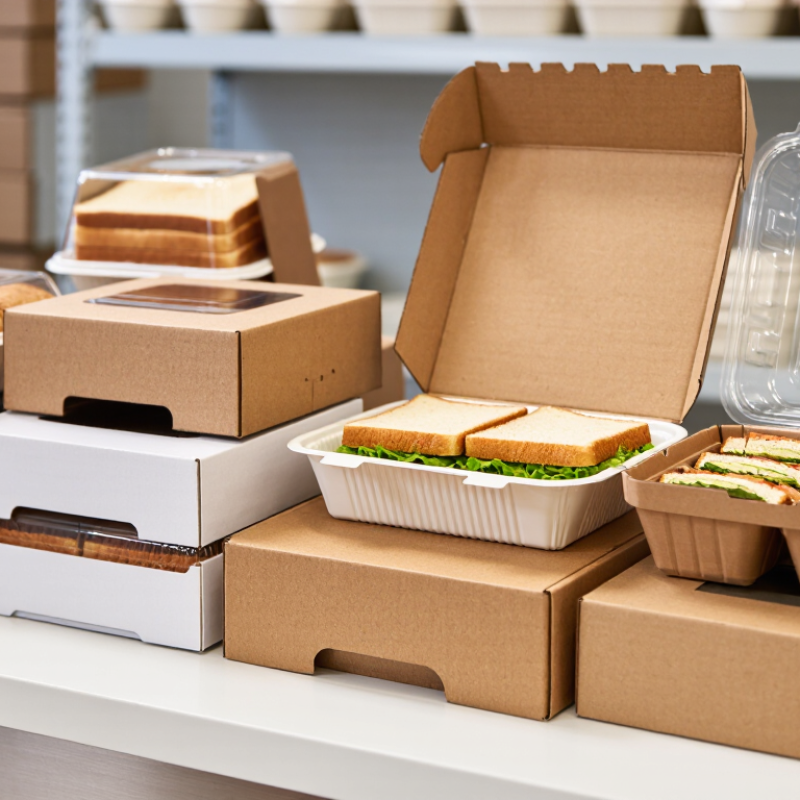
China Sandwich Box Industry Scope: Packaging Uses 40% of Global Plastic (OECD)
China Top Sandwich Box Manufacturer and Supplier
China’s sandwich box industry operates within a much larger packaging challenge. OECD research estimates that packaging uses about 40% of global plastic. This figure makes every takeaway container worth examining, including its material, weight, and disposal route.
An experienced Chinese manufacturer should treat packaging as a controlled production system. Food-grade paperboard, PP, and recyclable mono-material options require different testing methods. Suppliers should verify food-contact compliance, moisture resistance, seal strength, and dimensional accuracy. Fit matters. A box that closes poorly can waste food and increase returns. Batch records, material declarations, and pre-shipment inspections also support reliable sourcing.
Small choices matter.
A practical supplier can reduce excess material through nesting designs and lighter structures. Yet lightweight packaging is not automatically sustainable. It may lose rigidity, leak resistance, or stacking performance. This is where packaging decisions need honest review. Some production lines still depend heavily on virgin plastic, despite growing demand for recycled content. Recycling access also varies between regions, so one solution cannot suit every market. Buyers should compare tested performance, manufacturing consistency, and end-of-life conditions before selecting a sandwich box supplier. The most useful improvements often appear in ordinary details: stronger corners, clearer recycling guidance, and fewer unnecessary layers.
Materials and Food-Contact Safety: FDA, EU 1935/2004, and GB 4806
A reliable sandwich box begins with the material, not the printed design. OECD’s Global Plastics Outlook (2022) reports that packaging created about 40% of global plastic waste in 2019. This figure explains why food-contact safety and material efficiency must develop together. In factory audits, practical checks include pulp origin, recycled content, grease resistance, ink placement, adhesive selection, and batch traceability. Small details matter.
FDA compliance depends on the intended food, temperature, and contact conditions. Paperboard may require evaluation under 21 CFR 176.170, while plastic layers may fall under different FDA provisions. A supplier should provide formulation details, migration testing, and supporting declarations. “FDA approved” is often too vague. It can hide important limitations.
EU Regulation 1935/2004 requires materials to avoid harmful migration and unacceptable changes in food. Good manufacturing practice and a documented Declaration of Compliance are essential. For China, GB 4806 standards address food-contact materials, including paper, plastics, coatings, and adhesives. Testing should reflect real use, such as oily fillings, warm sandwiches, and refrigerated storage. EU and Chinese migration methods are not automatically interchangeable. That assumption needs review. Independent laboratory results, production records, and retained samples strengthen reliability. Some suppliers still treat compliance documents as paperwork rather than engineering evidence, which is a costly weakness.
China Top Sandwich Box Manufacturer and Supplier - Materials and Food-Contact Safety: FDA, EU 1935/2004, and GB 4806
Key food-contact regulatory framework milestones by publication year
The chart compares major regulatory framework milestones relevant to food-contact materials: the U.S. Food Additives Amendment of 1958, the EU Framework Regulation (EC) No. 1935/2004, and China's GB 4806.1-2016 General Safety Requirements for Food-Contact Materials and Articles. These years indicate framework or standard publication milestones, not product approval dates or equivalence between regulations.
Sources: U.S. FDA Food Contact Substances; EU Regulation (EC) No. 1935/2004; China National Standards Information Platform.
Sustainable Box Design: EU Targets 65% Packaging Recycling by 2025
China Top Sandwich Box Manufacturer and Supplier
Sustainable Box Design: EU Targets 65% Packaging Recycling by 2025
For sandwich box manufacturers and suppliers in China, the EU’s 65% packaging recycling target for 2025 changes product decisions. The figure concerns packaging waste recycling across the EU, not every individual box. Still, each box affects that result. In production trials, we examine fiber source, coatings, glue, inks, and folding accuracy. A box that looks recyclable may fail if a plastic film remains attached. Small details matter.
A practical design uses paperboard with clear fiber identification and minimal mixed materials. Water resistance remains important, especially around sauces and fresh vegetables. However, heavy coatings can complicate recycling. We test grease resistance, compression strength, and separation after use. We also check whether recycling facilities in the destination market accept the chosen structure. This step is often missed. It should not be.
Reliable suppliers should share material specifications, test records, and batch controls. They should explain what happens after disposal, rather than promise universal recyclability. Clear disposal guidance can reduce contamination from food residue. Users may need to empty, scrape, or separate components. Results vary between municipalities. Our own designs are not perfect; stronger moisture barriers can reduce fiber recovery. That trade-off deserves honest review and repeated improvement. Better packaging begins with measurable choices, not attractive claims.
Factory Quality Systems: ISO 9001, BRCGS Packaging, and QC Metrics
A dependable sandwich box manufacturer needs more than clean production lines. It needs a quality system that can be checked, repeated, and improved. ISO 9001 helps control documents, supplier approval, traceability, complaints, and corrective actions. At the factory floor, operators follow approved work instructions for folding, gluing, printing, and packing. Samples stay by batch. Evidence matters.
For food-contact packaging, BRCGS Packaging expectations add practical discipline. Teams inspect paperboard condition, ink control, adhesive handling, hygiene, and foreign-material prevention. A production record may show the board lot, machine number, operator, inspection time, and carton quantity. Quality checks often include dimensions, compression strength, folding accuracy, print registration, and seal performance. A simple defect trend can reveal more than one pass result. Rising glue stains may signal nozzle wear before boxes fail in transit.
We also review QC metrics weekly. Typical measures include first-pass yield, defect rate, customer complaints, rework hours, and corrective-action closure time. Numbers must support decisions. A low defect rate can still hide weak sampling. That is worth admitting. No factory is flawless. One missed barcode or uneven fold can interrupt a customer’s packing line. When this happens, the team records the cause, tests the correction, and checks later batches. Sometimes the process needs revision, not excuses.
Supplier Evaluation: MOQ, Lead Time, Customization, and Export Capacity
China Top Sandwich Box Manufacturer and Supplier
Evaluating a sandwich box supplier requires more than comparing unit prices. A reliable factory should state its minimum order quantity clearly, including separate limits for plain boxes, printed designs, and special materials. In practical sourcing projects, an MOQ of 1,000 to 5,000 units is common, but the number depends on box size, coating, and printing method. Ask for a written quotation. Verbal promises can change.
Lead time deserves close attention. Standard samples may take five to seven working days, while customized samples often require two weeks. Mass production can take 15 to 30 days after artwork approval and deposit payment. Confirm the production schedule, packaging method, and inspection process. Small details matter. A damaged carton can delay delivery even when production finishes on time.
Customization should cover dimensions, folding structure, grease resistance, ventilation, printing colors, and food-contact documentation. Request a physical sample before approving bulk production. Export capacity is equally important. Review previous shipment records, carton specifications, loading plans, and document accuracy. A supplier may claim strong capacity but provide little evidence. That is a warning sign. I have found that factories with clear communication are not always the cheapest, yet they usually reduce costly corrections. Still, no evaluation is perfect; production risks remain, especially during peak seasons and material shortages.
