
One Stop Solution for Office Furniture Supply
How to Choose the Right Cabinet Hinge in 2026?
Choosing the right Cabinet Hinge is a small decision with a daily impact. Every opening reveals its quality.
Grand View Research identifies renovation activity, modular cabinetry, and premium hardware as important cabinet hardware market drivers. The report also points toward demand for durable, concealed, and adjustable components. Meanwhile, the National Kitchen & Bath Association’s recent kitchen trends research shows continued investment in functional storage and user-friendly layouts. These findings matter because a hinge connects appearance with repeated mechanical stress.
Don Norman, a leading authority on human-centered design, wrote, “Good design is actually a lot harder to notice than poor design.” His observation fits cabinet hardware perfectly. A well-selected hinge disappears into smooth movement, even gaps, and quiet closing. A poor choice produces rubbing doors, visible misalignment, and early replacement.
There is no perfect hinge.
This guide compares overlay, inset, soft-close, clip-on, and 165-degree options. It also examines door weight, opening angle, cup drilling, material quality, and installation tolerance. For example, a tall oak door may need stronger support than a lightweight MDF door. A narrow corner cabinet may benefit from a wider opening angle. These details are easy to overlook.
The honest part is less glamorous. Product labels can simplify complex specifications, while installation errors often appear to be hinge failures. Readers should verify manufacturer load ratings and technical drawings before purchasing. Reliable brands, tested finishes, and accessible replacement parts usually matter more than a low initial price. The right Cabinet Hinge is not merely hardware; it is long-term cabinet performance.
Cabinet Hinge Basics: Types, Parts, and Opening Mechanisms
How to Choose the Right Cabinet Hinge in 2026?
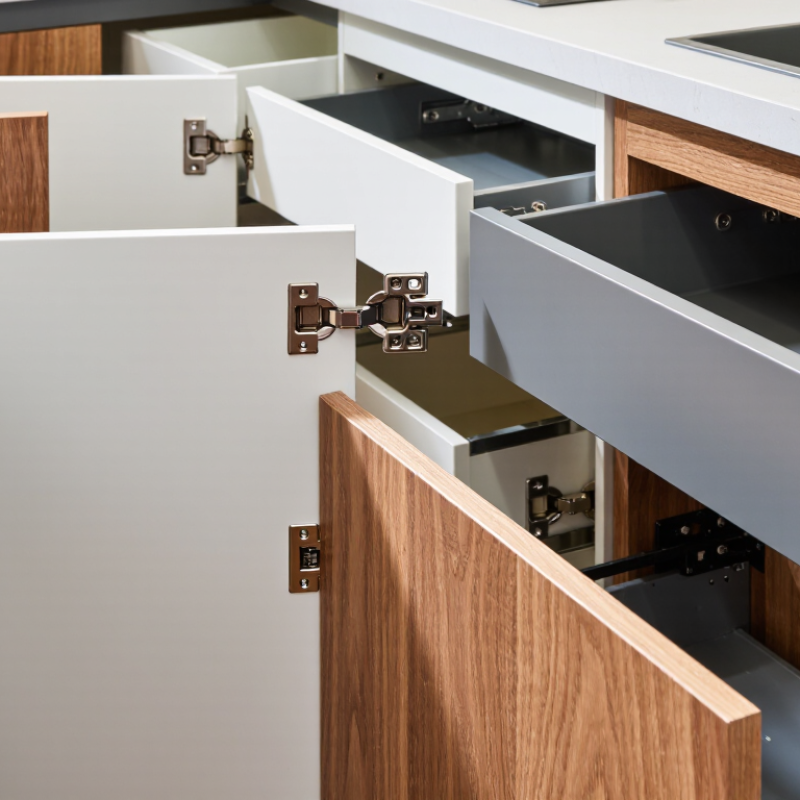
Cabinet hinges look small, but their parts control daily movement. A typical concealed hinge has a cup, arm, mounting plate, screws, and adjustment cams. The cup sits inside the door. The plate attaches to the cabinet side. Cams fine-tune height, depth, and side alignment. Surface-mounted hinges remain visible, while concealed hinges create a cleaner face. Semi-concealed models show part of the hinge. Each type suits a different cabinet style.
Opening mechanisms matter more than appearance. Full-overlay hinges cover the cabinet edge. Half-overlay hinges share one partition between two doors. Inset hinges place the door inside the frame. Common opening angles include 95, 110, and 165 degrees. Soft-close mechanisms slow the final movement. Push-to-open systems remove the need for handles. They can feel elegant, but poorly adjusted doors may reopen or sit unevenly.
The 2024 Freedonia Group analysis of cabinet hardware identifies remodeling as a major demand driver, making replacement compatibility increasingly important. Check the door thickness, overlay measurement, frame construction, and required opening angle before ordering. Industry installation guidance also emphasizes load capacity and cycle durability, not just visual fit. My practical mistake was choosing a wide-angle hinge for a tight corner. The door struck the adjacent panel. Measure the clearance first. A hinge can meet its rated cycles and still fail your room’s geometry. Corsets? No. Clearance wins.
| Hinge Type | Door Position | Typical Opening Angle | Adjustment | Visible When the Door Is Closed? | Best-Suited Cabinet Application | Key Advantages | Selection Considerations |
|---|---|---|---|---|---|---|---|
| Concealed European Hinge | Overlay, half-overlay, or inset, depending on the hinge cup and mounting plate | Approximately 95°–110° for common models; wider-angle versions are available | Usually three-way adjustment: side-to-side, height, and depth | No; the hinge is hidden inside the cabinet when the door is closed | Modern kitchen cabinets, wardrobes, bathroom vanities, and storage units | Clean appearance, replaceable parts, easy installation, and convenient door alignment | Choose the correct overlay, cup diameter, cup depth, mounting-plate height, and opening angle |
| Surface-Mount Hinge | Mounted on the outside surface of the cabinet and door | Commonly about 90°–180°, depending on the design | Limited; some models allow minor positioning adjustments through slotted holes | Yes; the hinge leaves remain visible | Face-frame cabinets, utility cabinets, furniture projects, and traditional designs | Simple installation, no large cup boring required, and suitable for thin doors | Check the visible finish, screw placement, door clearance, and required load capacity |
| Full-Overlay Hinge | The door covers nearly all of the cabinet side or face frame | Typically 95°–110° | Commonly three-way adjustable when used with a concealed hinge system | No when concealed; yes when used as a decorative surface hinge | Frameless cabinets and cabinets where the doors form a nearly continuous front | Creates a streamlined appearance and provides generous usable cabinet opening | Measure the door overlay carefully and allow clearance between adjacent doors |
| Half-Overlay Hinge | Two doors share one cabinet partition, with each door covering part of the partition | Typically 95°–110° | Often three-way adjustable with concealed hinge hardware | No when concealed | Pair of doors mounted on the same cabinet side or central partition | Efficient for multiple doors and reduces the amount of exposed cabinet structure | Use the correct half-overlay mounting plate and verify the gap between paired doors |
| Inset Hinge | The door sits inside the cabinet opening and aligns with the cabinet front | Usually about 95°–110°; specialized versions may open farther | Often three-way adjustable, although adjustment range depends on the design | No when concealed; decorative versions may remain visible | Inset cabinetry, built-in furniture, and projects requiring flush door fronts | Flush appearance and precise, furniture-style alignment | Requires accurate cabinet and door dimensions, consistent reveals, and sufficient internal clearance |
| Soft-Close Hinge | Available for overlay, half-overlay, and inset door positions | Usually about 95°–110° | Typically three-way adjustable; damping strength may be fixed or adjustable | No when concealed | Kitchens, bedrooms, bathrooms, and other cabinets where noise reduction is desirable | Slows the door before closing, reducing impact noise and stress on the cabinet | Confirm that the door weight and size fall within the hinge specification; very light doors may need a compatible damper |
| Clip-On Hinge | Overlay, half-overlay, or inset, depending on the mounting plate and hinge arm | Commonly about 95°–110° | Usually three-way adjustable | No when concealed | Cabinets requiring quick door removal for installation, cleaning, or servicing | Door can be detached from the mounting plate without removing cabinet screws | Check the release method, mounting-plate compatibility, and locking security before installation |
| Fixed-Plate Concealed Hinge | Generally used for overlay or inset doors according to the hinge geometry | Commonly about 95°–110° | Limited compared with clip-on, adjustable systems; some models provide basic alignment adjustment | No | Cost-sensitive furniture and cabinets with stable, accurately drilled components | Fewer components and a straightforward construction | Installation accuracy is especially important because the hinge position is less forgiving |
| Pivot or Knife Hinge | Door pivots from points near the top and bottom rather than from a side-mounted arm | Often approximately 90°–180°, depending on the pivot design | Usually limited; alignment is set during installation | Mostly hidden, although some decorative parts may be visible | Inset doors, glass doors, tall cabinet doors, and specialty furniture | Can support a clean appearance and unusual door layouts | Requires accurate top-and-bottom positioning and adequate clearance for the pivot path |
| Glass-Door Hinge | Designed for overlay or inset glass panels, often with clamps or specialized fittings | Commonly about 90°–110° | Varies; concealed glass hinges may offer three-way adjustment, while clamp styles may offer less | Depends on the design; some are concealed and others are intentionally visible | Display cabinets, glass-front kitchen units, and bathroom storage | Designed to hold glass without conventional wood-screw cup installation | Verify glass thickness, edge condition, hole requirements, load rating, and the need for protective pads |
| Wide-Angle Hinge | Usually used with overlay or inset doors where extra access is needed | Approximately 120°–170°, depending on the model | Often three-way adjustable | No when concealed | Corner cabinets, pull-out storage, appliance garages, and cabinets near adjacent walls | Provides a larger opening and improves access to cabinet contents | Check for collisions with neighboring doors, walls, handles, shelves, and internal fittings |
| Self-Closing Hinge | Available in several overlay and inset configurations | Commonly about 90°–110° | Varies from limited to three-way adjustment | Usually no when concealed; decorative versions may be visible | Utility cabinets, workshop storage, and doors that should return to the closed position | Uses spring force to pull the door closed without requiring a separate catch | Spring tension can affect operating feel; confirm that it matches the door weight and use frequency |
| Butt Hinge | Typically fitted between the door edge and cabinet frame or carcass | Often about 90°–180° | Usually minimal; alignment relies on accurate mortising and installation | Yes, unless specially recessed or concealed | Traditional furniture, framed cabinets, chests, and custom woodworking | Strong, familiar, and available in many sizes and finishes | May require mortising; select a leaf size and screw pattern suitable for the door weight |
| Continuous or Piano Hinge | Runs along much or all of the door height | Usually approximately 90°–180° | Little or no built-in adjustment | Yes, unless installed in a concealed position | Long, narrow, heavy, or frequently used doors where load distribution is important | Distributes the door load over a long length and helps reduce localized stress | Requires accurate cutting and straight installation; verify hinge length, thickness, and material |