
One Stop Solution for Office Furniture Supply
10 Tips for Choosing Commercial Overhead Doors
Choosing the right Commercial Overhead Doors affects daily safety, energy use, security, and workflow. A warehouse door may open dozens of times each day, exposing the interior to weather, dust, and temperature changes. A loading dock needs different performance from a service garage or a refrigerated facility. The best choice begins with the building’s actual conditions, not a product photo.
This guide explores ten practical tips for evaluating door materials, insulation, operating speed, safety systems, and maintenance demands. It also considers opening size, traffic frequency, wind exposure, available headroom, and long-term operating costs. Experienced facility managers often measure these details before requesting quotes. Small errors matter. A few inches of lost clearance can disrupt forklifts, trucks, and overhead equipment.
Manufacturers and qualified installers can explain tested ratings, installation limits, and service requirements. Still, their recommendations should match your site, budget, and maintenance capacity. A stronger door is not always the better door. An expensive high-speed model may create unnecessary costs in a low-traffic building. Conversely, a basic door can fail quickly under constant use. Conditions change, too. Seasonal weather, expanding operations, and aging equipment may challenge an original decision. These ten tips provide a practical framework for comparing options carefully, asking better questions, and selecting Commercial Overhead Doors that support reliable operation over many years. Safety remains essential. So does honest evaluation.
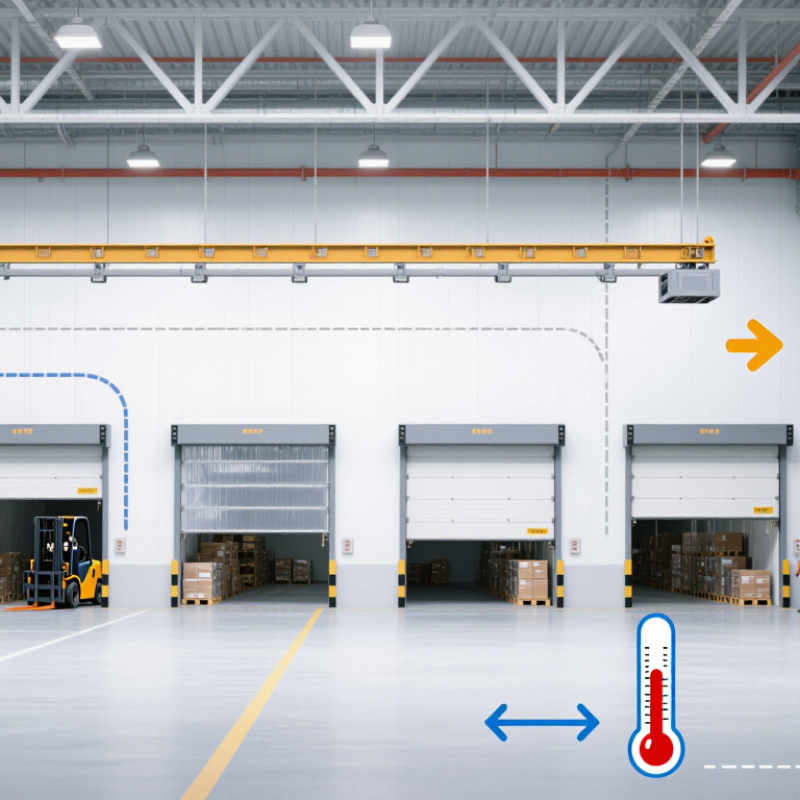
Define the Operational Needs of Your Commercial Facility
Choosing commercial overhead doors starts with the facility’s daily movement, not the door’s appearance. Record vehicle types, opening dimensions, traffic frequency, operating hours, and delivery schedules. Measure the movement. A loading dock serving forklifts needs different performance than a low-traffic storage room. Include temperature, dust, humidity, wind exposure, and available headroom. Small details often decide whether a door performs reliably.
The U.S. Department of Energy’s 2018 Commercial Buildings Energy Consumption Survey estimated 6.8 quadrillion Btu of commercial energy use. That figure reinforces the value of controlling conditioned air. Frequent openings may justify high-speed operation, tighter seals, and automatic closing controls. However, energy savings should not override safe visibility, pedestrian separation, or emergency access. DASMA Technical Data Sheet 102 highlights the importance of proper door selection, installation, and maintenance for safe operation. Inspect photo sensors, warning signals, bottom edges, and manual release systems before approval.
Ask maintenance teams about previous failures. Ask operators what slows them down. Their answers may expose problems that specifications miss. A perfect operational record is rarely available. That is acceptable, but assumptions should be documented. Compare expected cycles, repair access, replacement-part availability, and lifecycle cost. FM Global property-loss guidance also emphasizes protecting openings from weather and operational damage. Choose a door that fits the facility’s real rhythm, even when that rhythm is irregular. Recheck the decision after seasonal demand changes.
10 Tips for Choosing Commercial Overhead Doors - Define the Operational Needs of Your Commercial Facility
| No. | Operational Need | Recommended Data to Confirm | Practical Selection Guidance | Typical Planning Range | Why It Matters |
|---|---|---|---|---|---|
| 1 | Daily traffic volume | Door openings per day and peak openings per hour | Select a door and operating mechanism rated for the facility’s actual traffic level, including short-term peaks. | Low: under 20 cycles/day Moderate: 20–100 High: over 100 | Higher traffic increases wear on springs, rollers, hinges, guides, and operators. |
| 2 | Opening dimensions | Required clear width, clear height, headroom, and side room | Measure the largest vehicle, equipment, or load that must pass through, then verify structural clearances before ordering. | Allow additional clearance for vehicle mirrors, payload variation, and safe operator visibility. | Insufficient clearance can cause collisions, loading delays, and costly building modifications. |
| 3 | Operating speed | Maximum acceptable open and close time | Use faster-opening equipment where doors separate conditioned areas, support frequent deliveries, or control vehicle queues. | Conventional sectional doors: often about 15–30 seconds per cycle High-speed systems: commonly several times faster | Faster operation can reduce air exchange, waiting time, and exposure to weather or contaminants. |
| 4 | Thermal performance | Indoor temperature target, climate, and energy-control requirements | Consider insulated panels, perimeter seals, bottom seals, and reduced air leakage for conditioned warehouses, workshops, and service areas. | Insulated door panels are commonly specified by an R-value; the required value depends on climate and building design. | A properly sealed and insulated opening helps stabilize indoor temperatures and reduce HVAC loads. |
| 5 | Environmental exposure | Rain, snow, salt, humidity, dust, chemicals, and wash-down conditions | Choose corrosion-resistant hardware, suitable finishes, drainage provisions, and materials compatible with cleaning agents. | High-moisture or corrosive areas require more frequent inspection and protective maintenance. | The environment directly affects panel coatings, springs, tracks, fasteners, and electrical components. |
| 6 | Wind and weather resistance | Project location, building exposure, design wind speed, and applicable code | Specify wind-load performance using local building-code requirements and the building’s exposure category; do not rely only on a generic rating. | Wind requirements vary significantly by location, building height, terrain, and opening position. | Correct wind design helps protect the door, surrounding structure, inventory, and occupants. |
| 7 | Safety and visibility | Pedestrian traffic, forklift routes, blind spots, and emergency access needs | Include photo eyes or monitored sensing edges, warning signals, manual release provisions, and vision panels where appropriate. | Safety devices should be selected and tested according to applicable regulations and the operator’s risk assessment. | Visibility and automatic reversal features help reduce contact incidents and equipment damage. |
| 8 | Material and impact exposure | Forklift activity, vehicle contact risk, cleaning process, and required appearance | Compare steel, aluminum, insulated panels, and flexible curtains based on impact risk, corrosion exposure, visibility, and repairability. | High-impact areas may benefit from flexible or breakaway designs; secure exterior openings may require reinforced construction. | The right material can reduce downtime and replacement costs after accidental contact. |
| 9 | Access control and integration | Required control devices, security zones, vehicle identification, and automation systems | Plan compatibility with card readers, remote controls, loop detectors, pull cords, timers, fire-alarm interfaces, and building management systems. | Use automatic closing or restricted access where security, temperature control, or process separation is important. | Integrated controls improve consistency, traceability, and operational security. |
| 10 | Maintenance and lifecycle cost | Inspection access, service intervals, spare parts, downtime cost, and expected service life | Compare total cost of ownership rather than purchase price alone; document lubrication, balance checks, safety testing, and replacement-part requirements. | Inspection frequency should increase with cycle count, impact exposure, corrosion, and safety-critical use. | Planned maintenance helps identify worn components before they cause failures or safety hazards. |
Planning note: Final door dimensions, wind-load ratings, safety equipment, and installation details should be verified against the project drawings, local building codes, electrical requirements, and the manufacturer’s published specifications.